
At a time when digital transformations are accelerating and the character of financial worth is altering, British author and economist Diane Coyle returns to ask a elementary query: Is GDP nonetheless able to measuring an financial system whose Most worthy elements are now not tangible?
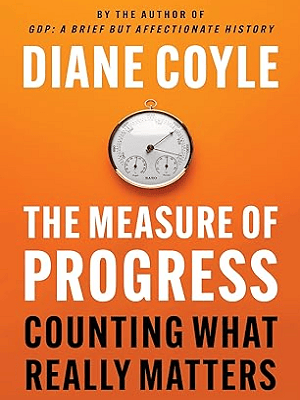
In her new e-book, “The Measure of Progress: Counting What Actually Issues,” Coyle provides a essential and daring imaginative and prescient of the shortcomings of conventional financial statistics, and requires a brand new framework for measuring wealth that’s suitable with the period of the digital and immaterial financial system.
The e-book is stuffed with concepts starting from economics, statistics, and ethics, however it avoids going into the center of the query: Why did we attain this example, and who moved the compass?
Questions of development and productiveness are more and more necessary in public debate inside Western democracies. Diane Coyle, professor of public coverage on the College of Cambridge and probably the most outstanding up to date economists, devotes her new e-book to analyzing the roots of this controversy and offering a coherent theoretical framework for addressing the gathered flaws within the strategies of measuring the financial system.
Previous measuring instruments
The issue, says Coyle, isn’t just outdated measurement instruments, however that total sectors of non-registered work – corresponding to care and home work – are being ignored although they’re important pillars of financial exercise..
The e-book focuses on exhibiting the shortcomings of the statistical framework that also depends on a system developed within the Forties to measure strong industrial economies.
Immediately, the West lives in a very completely different financial system, which has been modified by three intertwined forces: globalization, digitization, and finance. These are forces that Cowell didn’t explicitly title, however she depends on them in her evaluation.
These transformations raised dwelling requirements for many years, however in addition they produced a extra complicated and fewer clear financial system.
Weightless financial system
In her new e-book, Cowell returns to an thought she put ahead practically three many years in the past in her e-book “The Weightless World,” when she argued that financial worth is now not measured by the load of products produced, however fairly by companies and intangible belongings, from software program to knowledge to technical experience.
This pattern, she says, has change into extra evident as we speak: Even main manufacturing corporations now rely for his or her revenues on companies associated to the product greater than on the product itself, corresponding to upkeep, evaluation, and embedded software program..
As worth chains disintegrate throughout borders, it has change into virtually unimaginable to find out the place worth is definitely created inside these complicated international networks. Therefore, fashionable economies want a extra versatile and complete framework to grasp what they really produce.
Why did I fail to develop?
Coyle begins her e-book by explaining the significance of financial development and its position in decreasing political tensions and absorbing social shocks.
It signifies that the slowdown in productiveness over the previous seventeen years in most G7 nations, because the 2008 disaster, was accompanied by the rise of left- and right-wing populist waves.
Regardless of the widespread unfold of digital expertise on this interval, productiveness beneficial properties remained restricted, a puzzle that has puzzled economists.
This puzzle turns into extra complicated as synthetic intelligence enters a brand new section, with corporations promising to convey a few “productiveness revolution,” whereas Coyle factors out that it’ll make measurement tougher and exacerbate current contradictions..
Statistics are a mirror of energy
Coyle delves into the historical past of financial statistics to indicate how they type a essential basis for good governance. The state can not handle its financial system with out correct measuring instruments. With out it, you change into “blind” to actuality.
Nonetheless, statistics are usually not impartial. They’re a product of prevailing energy constructions, and on the identical time they create a brand new actuality as a result of they affect the insurance policies on which they’re constructed..
Coyle notes giant gaps within the statistical system adopted as we speak, particularly after the transformations led to by digitization and international mobility of manufacturing components, in addition to in measuring costs and inflation.
It concludes that GDP is unable to signify the worth of the atmosphere or the true influence of intangible financial actions..
Did somebody deliberately make economics ambiguous?
Though Cowell explains how the financial system modified, writer James Hodgson believes that her e-book avoids a elementary query: Why did the financial system change into this fashion? Was the state’s diminished capability to measure – and thus intervene – merely a spontaneous outcome? Or was it intentional?
Researchers within the historical past of neoliberalism verify that the liberation of capital from democratic management because the Nineteen Seventies was an organized mission applied by political and financial elites, which led to a world financial system that could be very complicated and tough to measure, and due to this fact much less topic to the desire of states..
Therefore, Hodgson fears that any try to develop measurement instruments and empower the state – as Coyle suggests – could run into resistance from the identical elites who’ve benefited from this example..
Is neoliberalism in decline?
Hodgson admits that it could be too early to speak concerning the finish of neoliberalism, however the ruling ideology of Western financial insurance policies is beneath rising stress, particularly after the protectionist insurance policies of the Trump administration and the state’s return to industrial intervention.
Nonetheless, Coyle doesn’t handle this shift in her e-book regardless of her participation in a college convention on “Submit-Neoliberal Industrial Coverage.”
Hodgson believes that this absence represents a niche in work geared toward redefining how the financial system is measured and directed. Slightly, he goes additional by proposing a “rebellious possibility” in keeping with which the answer might not be to broaden the measurement instruments to accommodate the present financial system, however fairly to reform the financial system itself to change into extra measurable and to realize broader welfare, as was the case many years in the past..
In direction of a brand new debate
Within the e-book’s conclusion, Coyle provides an alternative choice to the GDP framework, however dismisses measures of well-being as subjective and biased.
As a substitute, it requires a framework primarily based on measuring complete wealth: that’s, bodily, human, social, organizational and environmental capital, and the complementary relationships between them. This framework continues to be preliminary, however – in her view – ought to be a place to begin for a broader dialogue about find out how to restore the flexibility of nations to grasp what’s going on inside their economies..
Hodgson believes that the e-book opens a brand new door for dialogue in political financial system, and constitutes an necessary addition to Cowell’s analysis profession, even when it leaves some questions unanswered..
Supply: LSE UK web site


