
Whereas the subsequent main occasion on the calendar is the FIFA World Cup 2026, set to happen in the USA, Mexico, and Canada subsequent summer season, a lot of the eye is already shifting towards the 2030 version — one other multi-nation event. Spain, Portugal, and Morocco will host the vast majority of matches, although the situation of the ultimate stays unclear.
Stories counsel there are presently three doable situations for the championship match. Two of them are in Spain, on the nation’s most iconic stadiums: Actual Madrid’s Santiago Bernabeu Stadium and Barcelona’s Camp Nou. Nonetheless, Morocco has expressed a powerful need to stage the ultimate in Casablanca.
The president of the Royal Spanish Soccer Federation gave a agency response when requested in regards to the subject. “I feel it will be inconceivable to clarify that Spain will not be the host of the World Cup remaining,” stated Rafael Louzan throughout a chat on the Nueva Economia Discussion board, in keeping with Marca.
“Spain has 55% of the organizational weight. It’s solely pure that Spain ought to host the ultimate,” Louzan continued, outlining his most important argument. “There shall be a five-billion-euro impression on GDP and a pair of.5 billion euros invested in stadium renovations… these of us concerned in soccer want to remain united.”
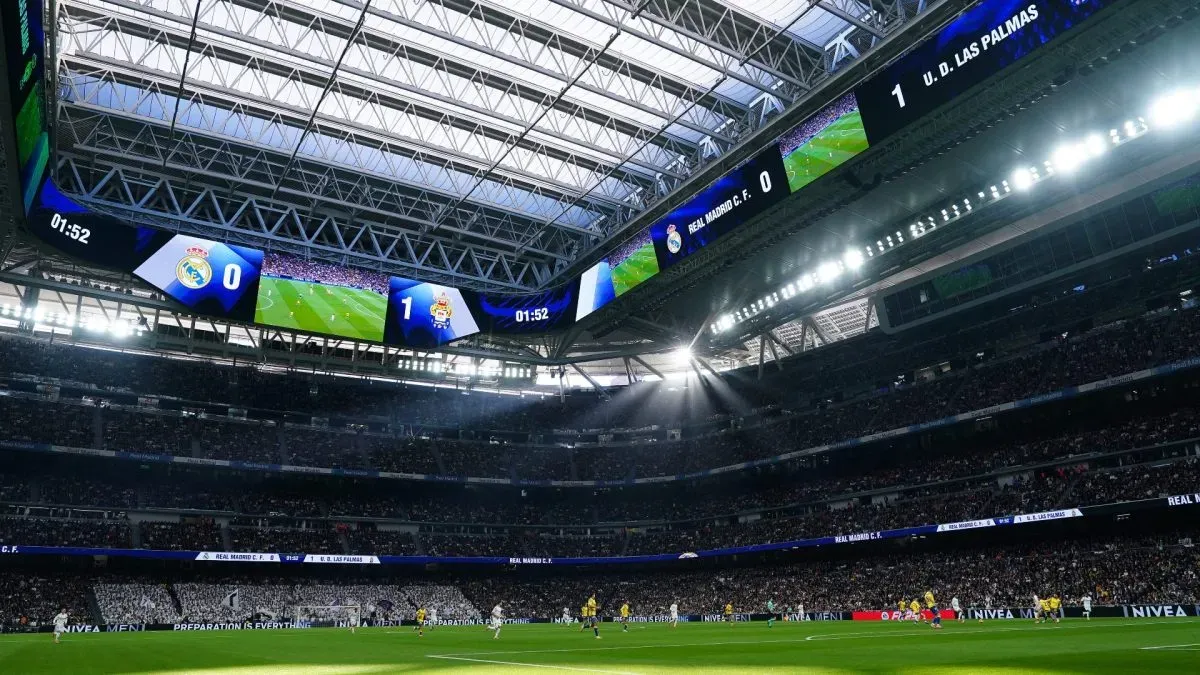
The Santiago Bernabeu Stadium is likely one of the doable venues for the World Cup 2030 remaining.
A historic World Cup in 2030
Simply because the World Cup 2026 will make historical past as the primary event that includes 48 groups — and the primary hosted by three completely different nations — the 2030 version might take issues even additional. Relating to the format, there are proposals to broaden participation to 64 groups, although that concept has sparked heated debate.

see additionally
Dimension vs. success: 10 most populous nations but to achieve FIFA World Cup
One factor is for certain: the World Cup 2030 would be the largest in historical past by way of geographic attain. To commemorate the centennial of the first-ever World Cup, a number of matches will happen in South America, with Uruguay, Argentina, and Paraguay chosen as host nations.
The vast majority of video games will then transfer to the three most important host nations: Spain, Portugal, and Morocco. This setup brings two unprecedented milestones — will probably be the primary World Cup hosted by six completely different nations and the primary ever performed throughout three continents: South America, Europe, and Africa.
Potential venues for the World Cup 2030
Throughout his look on the Nueva Economia Discussion board, Royal Spanish Soccer Federation president Rafael Louzan additionally mentioned the choice course of for the 2030 venues, emphasizing that “the ultimate determination will relaxation with FIFA.”
see additionally
Unbelievable FIFA World Cup reality you’ll have to learn twice: 4 of 5 giants received’t be current at 2026 version
Nonetheless, hypothesis continues to swirl across the cities and stadiums most probably to host event matches. In South America, Estadio Monumental in Buenos Aires, Estadio Centenario in Montevideo (which hosted your entire 1930 World Cup), and Estadio Osvaldo Dominguez Dibb in Asunción look like the highest candidates.
In Morocco, six cities are in rivalry to host video games — Agadir, Casablanca, Fez, Marrakesh, Rabat, and Tangier. In Casablanca, the development of the Hassan II Stadium, with a projected capability of 115,000 spectators, positions it as Spain’s most important rival for the best to stage the ultimate.
In Portugal, the focus will fall on three storied grounds: Estadio da Luz (Benfica) and Estadio Jose Alvalade (Sporting CP) in Lisbon, and Estadio do Dragao in Porto, every representing one of many nation’s soccer powerhouses.
Lastly, Spain is anticipated to characteristic round eight host cities for the World Cup 2030. Two of them could have a number of venues: Madrid, with Santiago Bernabeu Stadium and Metropolitano Stadium (Atletico Madrid), and Barcelona, with Camp Nou and Estadi Cornella-El Prat (Espanyol). The opposite cities embody La Coruña, Bilbao, Las Palmas, San Sebastian, Seville, and Zaragoza.